Silicone Rubber Impression Materials
Silicone Rubber Impression Materials
- Developed to address the drawbacks of polysulfides.
- Silicone rubbers are cleaner, more pleasant, and easier to use.
Types
- Condensation Silicones (older, conventional type)
- Addition Silicones (more modern and stable)
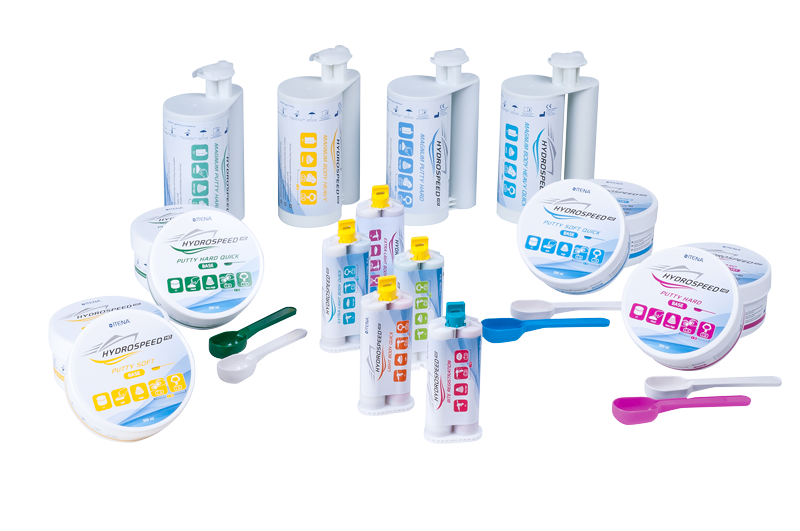
These are available in various colors and viscosities, often color-coded for identification.
Condensation Silicone
Packaging
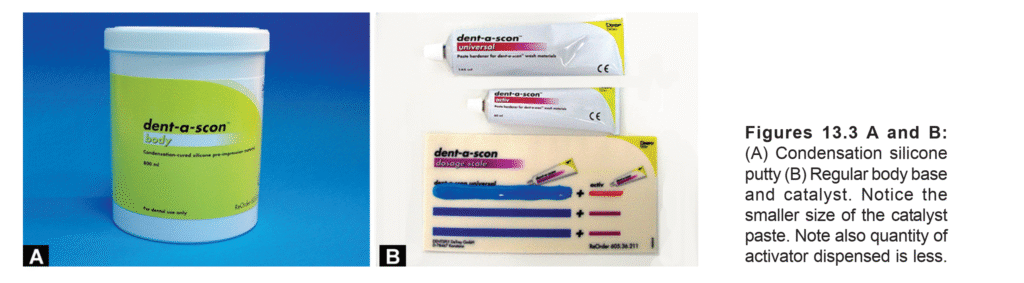
- Pastes in tubes (base in large tube, catalyst in smaller one)
- Putty in large jars; catalyst as paste or liquid
- Available Viscosities: light, medium, and putty

Common Brands
- Sil 21, Coltex, Dent-a-scon
Composition
- Base:
- Hydroxy-terminated polydimethyl siloxane
- Fillers (colloidal silica or metal oxides): 35–75%
- Pigments
- Accelerator:
- Orthoethyl silicate (crosslinking agent)
- Stannous octoate (catalyst)
Setting Reaction
- Condensation polymerization between orthoethyl silicate and siloxane terminals
- Exothermic reaction (~1°C)
- By-product: Ethyl alcohol, which evaporates and causes shrinkage
Tray Adhesive
Contains poly(dimethyl siloxane) and ethyl silicate to bond physically and chemically to tray and impression material.
Properties
- Pleasant color and odor, though skin contact should be avoided
- Setting time: 6–9 minutes; mixing time: 45 seconds
- Excellent surface detail reproduction
- Moderate dimensional stability:
- Shrinkage from alcohol loss (0.4–0.6%)
- Immediate pouring recommended
- High permanent deformation (1–3%)
- Lower tear strength than polysulfide (~3000 g/cm)
- Stiffer and harder; requires 3 mm tray spacing
- Hydrophobic—requires dry field and careful pouring
- Electroplatable, preferably with silver
- Shelf life: Slightly shorter than polysulfides due to silicate instability
Manipulation of Condensation Silicone Impression Materials
Putty Form
- The required number of base scoops is taken.
- A small, manufacturer-recommended amount of catalyst (liquid or paste) is added.
- Mixing is done by kneading between fingers until a uniform, streak-free putty is formed.
Paste Form
- Base and catalyst are usually unequal in amount.
- The required length of catalyst paste is indicated on the mixing pad.
- Mixed with a spatula, ensuring uniformity.
Note: The catalyst paste is generally less in volume compared to the base, unlike addition silicones.
Addition Silicones (Polyvinyl Siloxane – PVS)
Addition silicones, also known as polyvinyl siloxanes (PVS), were introduced after condensation silicones. They offer superior properties, making them the most widely used elastomeric impression material today.
Packaging
- Tubes: Base and catalyst in equal-sized tubes
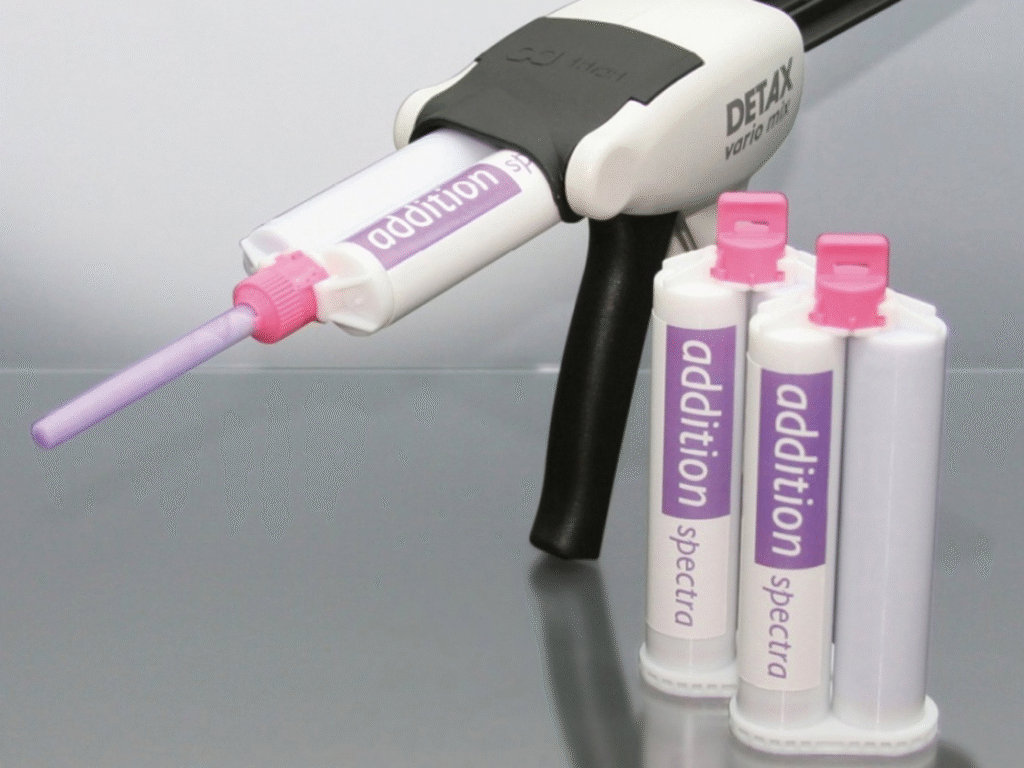
- Cartridges: For automatic mixing using a dispensing gun
- Putty jars: Two equal-sized plastic jars
- Automated dispensing systems: e.g., Pentamix (ESPE), which mixes and dispenses material at the push of a button
Available Viscosities
- Light body
- Medium body
- Heavy body
- Putty
Different viscosities are color-coded (e.g., orange, green, blue) for easy identification.
Common Brands
- Reprosil (Dentsply)
- Provil
- President (Coltene)
Composition
| Component | Base | Catalyst (Accelerator) |
|---|---|---|
| Polymer | Divinyl polysiloxane | Poly(methyl hydrogen siloxane) |
| Additives | Other siloxane prepolymers, fillers | Platinum salt (chloroplatinic acid), palladium (hydrogen absorber), retarders, fillers |
Setting Reaction
- Addition polymerization between vinyl groups and silane groups
- Catalyst: Platinum salt
- No by-products are produced if the mixture is balanced
- If unbalanced, hydrogen gas is released, causing air bubbles in the stone cast
- Palladium is added to absorb excess hydrogen
⚠️ Avoid sulfur contamination (e.g., from latex gloves) as it can inhibit setting. Use vinyl gloves instead.
Properties
- Pleasant odor and color
- Avoid skin contact (can cause allergic reactions)
- Excellent detail reproduction
- Setting time: 5–9 minutes
Mixing time: 45 seconds - Best dimensional stability among elastomers
- Low curing shrinkage (0.17%)
- Lowest permanent deformation (0.05–0.3%)
- Delay pouring of the model by 1–2 hours if hydrogen gas is present
- Good tear strength (3000 g/cm)
- Highly hydrophobic
- Field must be completely dry
- Some products include surfactants to improve hydrophilicity
- Electroplatable with silver or copper
- Surfactants in hydrophilic variants may reduce electroplating quality
- Low flexibility; harder than polysulfide
- Requires 3 mm spacing in the tray
- Handle cast removal carefully to prevent fracture
- Shelf life: 1–2 years
Manipulation of Addition Silicone Impression Materials
Putty Form
- Equal scoops of base and catalyst are dispensed.
- Mixed by hand kneading using clean fingers until a uniform, streak-free consistency is achieved.
- Latex gloves should not be used (contain sulfur, which retards setting); instead, use vinyl gloves.
Paste Form
- The mixed paste should be spread thinly before loading into the tray to release air bubbles.
- Equal lengths of base and catalyst pastes are placed side-by-side on a mixing pad (in cartridges or tubes).
- A stiff tapered spatula is used for incorporation.
- Mixing time is approximately 45 seconds.
Automatic Mixing (Cartridge Form)
- Comes in double-barrel cartridges with automixing tips.
- Mixing occurs within the tip as the materials pass through internal spirals.
- Large quantities can be mixed with mechanical devices like Pentamix (ESPE), which ensures consistent mix with fewer bubbles and quicker working time.