

Overview of Complete Dentures
A Comprehensive Overview of Complete Dentures: Components, Materials, and Fabrication
1. Introduction and Definition
Complete denture prosthodontics is the branch of dentistry concerned with the art and science of restoring an edentulous mouth by replacing the natural teeth and associated structures of the maxilla and mandible with an artificial prosthesis.
1.1 Functions of a Complete Denture
The primary functions of a complete denture are to restore aesthetics (facial contours, vertical dimension), mastication (through balanced occlusion), and phonetics (speech).
- Aesthetics: The denture must restore lost facial contours and vertical dimension of occlusion.
- Mastication: Proper balanced occlusion is critical for denture stability and efficient chewing function.
- Phonetics: A key function of the denture is to restore the patient’s speech capabilities
2. Component Parts and Surfaces of a Complete Denture
A complete denture is a complex prosthesis composed of distinct parts and surfaces, each with a specific function.
2.1 Surfaces
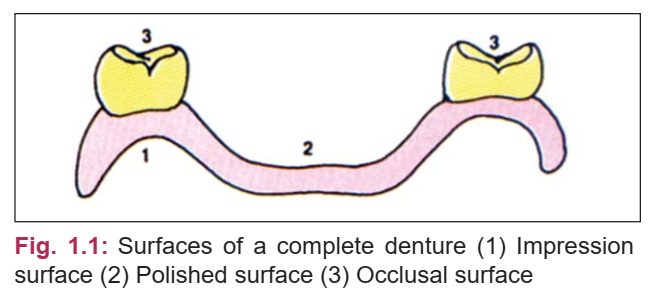
A denture has three critical surfaces:
- Impression Surface (Intaglio): The tissue-fitting surface that is a negative replica of the oral mucosa. It must be perfectly adapted to ensure support and retention.
- Polished Surface (Cameo): The external surfaces of the flanges and palate. It must be highly polished to prevent plaque and food accumulation and is shaped to aid denture stability through muscular contact.
- Occlusal Surface: The surface of the teeth that makes contact with the opposing dentition. Its design is crucial for efficient mastication and stability.
2.2 Component Parts
The four main components
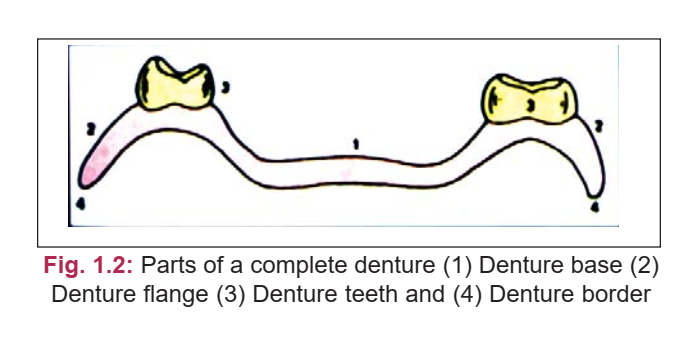
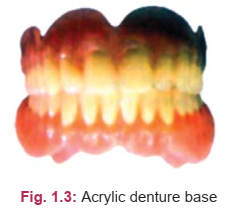
- Denture Base: The foundation resting on the oral mucosa that supports the teeth. It distributes occlusal forces.
- Denture Flange: The vertical extension from the base into the vestibules. It provides peripheral seal and stability.
- Denture Border: The junction between the polished and impression surfaces, critical for achieving the peripheral seal.
- Denture Teeth: The artificial teeth responsible for function and aesthetics.
2.3 Denture Base Materials
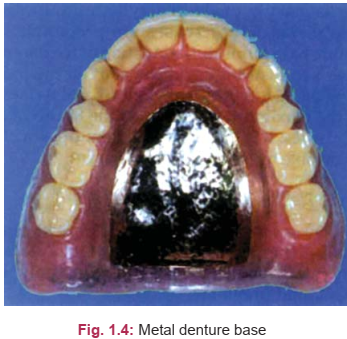
The denture base can be fabricated from different materials, each with distinct advantages and disadvantages.
Table 1: Comparison of Denture Base Materials
| Property | Acrylic Resin Base | Metal Base (Co-Cr, Gold Alloys) |
|---|---|---|
| Aesthetics | Excellent, mimics gingival color | Poor, metallic appearance |
| Thermal Conductivity | Poor (reduced sensory feedback) | Excellent (good sensory feedback) |
| Strength & Thickness | Requires thicker sections | Strong even in thin sections |
| Weight | Lighter | Heavier (improves retention in mandible) |
| Fabrication & Repairs | Easy to fabricate and rebase | Complex, time-consuming, cannot be rebased |
| Cost | Economical | Expensive |
2.4 Denture Flanges
Flanges are named for their anatomical location and have specific design considerations:
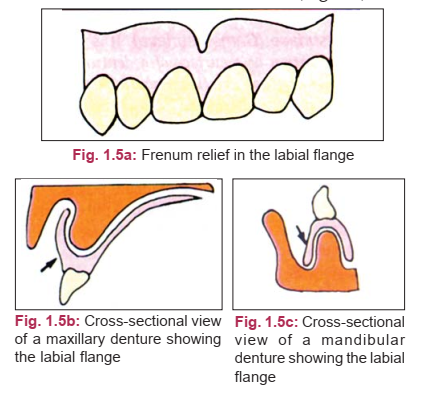
- Labial Flange: Occupies the labial vestibule, provides lip support, and is notched for the labial frenum.
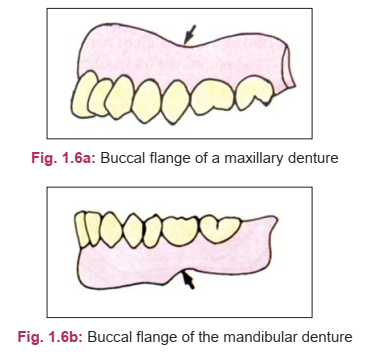
- Buccal Flange: Occupies the buccal vestibule, provides cheek support, and transmits force to the buccal shelf in the mandible. Requires relief for the buccal frenum.
- Lingual Flange (Mandibular only): Extends into the alveololingual sulcus. It must contact the floor of the mouth for a seal but must not be overextended to avoid displacement by tongue movements.
3. Denture Teeth: Material and Morphological Classification
Denture teeth are classified based on their material composition and occlusal morphology (anatomy).
3.1 Classification by Material
Table 2: Comparison of Acrylic and Porcelain Denture Teeth
| Property | Acrylic Teeth | Porcelain Teeth |
|---|---|---|
| Abrasion Resistance | Low | High |
| Adjustability | Easy to adjust | Difficult to trim |
| Bonding to Base | Chemical bond | Mechanical retention |
| Staining | Susceptible | Resistant |
| Percolation | Absent | Present |
| Clicking Sound | Absent | Present |
| Fabrication | Easy | Difficult |
| Trauma to Ridge | Less (softer) | More (harder) |
- Other Materials: IPN Resin Teeth offer a compromise with better wear resistance than conventional acrylic. Gold Occlusals are ideal for opposing natural teeth but are costly. Acrylic with Amalgam Stops is an economical method to improve wear.
3.2 Classification by Morphology (Cusp Angle)
The choice of tooth morphology is a critical biomechanical decision.
- Anatomic Teeth (≈33° Cusp Angle):
- Advantages: Excellent aesthetics and masticatory efficiency; allow for balanced occlusion in eccentric positions; guide the mandible into centric relation.
- Disadvantages: Magnify horizontal forces on the residual ridge; precise setting is crucial.
- Semi-anatomic Teeth (0°-30° Cusp Angle): A compromise offering some aesthetics and function with reduced lateral forces. Historical designs include the Channel Tooth (Sears) and Scissor Bite Tooth (Avery Brothers).
- Non-anatomic (0° or Cuspless) Teeth:
- Advantages: Minimize horizontal forces; ideal for patients with bruxism, neuromuscular disorders, or highly resorbed ridges due to their freedom of movement.
- Disadvantages: Poor aesthetics; lower masticatory efficiency; balanced occlusion must be achieved through denture design (e.g., balancing ramps), not tooth form. Historical designs include the Inverted Cusp (Hall), Trukusp (Myerson), and Non-lock Tooth (Swenson).
- Specialized Types: Cross-bite Teeth for jaw discrepancies and Metal Insert Teeth for increased cutting efficiency.
Key Clinical & Laboratory Steps:
- Diagnosis & Impressions: Comprehensive examination leads to a primary (preliminary) impression.
- Cast & Tray Fabrication: The primary cast is used to fabricate a custom (special) tray for the final impression.
- Final Impression & Master Cast: The secondary impression, involving border moulding, captures the precise functional anatomy. The master cast is poured from this impression.
- Jaw Relation Records: Vertical dimension, centric relation, and eccentric records are made using record bases and occlusal rims. A face-bow transfer ensures accurate spatial orientation of the maxillary cast on the articulator.
- Tooth Arrangement & Try-in: Teeth are set on the articulator for balanced occlusion and evaluated in the patient’s mouth for aesthetics and function.
- Processing & Insertion: The wax denture is converted to acrylic resin (processing), finished, polished, and inserted. Post-insertion care and adjustments are critical for long-term success.


