


A Guide to Essential Lateral Cephalometric Landmarks
In orthodontics and dentofacial orthopedics, the lateral cephalometric radiograph is that blueprint. It provides a window into the complex relationship between the skull, jaws, and teeth, allowing us to move beyond simple dental alignment and understand the underlying skeletal framework.
But to read this blueprint, you must first master its language: the cephalometric landmarks. These precise points are the foundation of any analysis, enabling diagnosis, treatment planning, and assessment of growth or treatment changes.
This guide will walk you through the most important lateral cephalometric landmarks, categorized for clarity.
1. Cranial Base Landmarks: The Foundation
These points establish the reference plane (SN Plane) from which many measurements are made. They represent the stable foundation upon which the jaws are built.
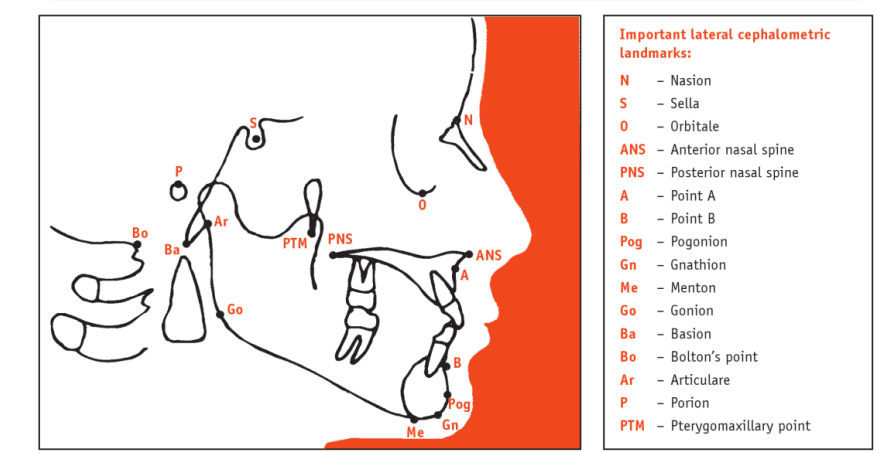
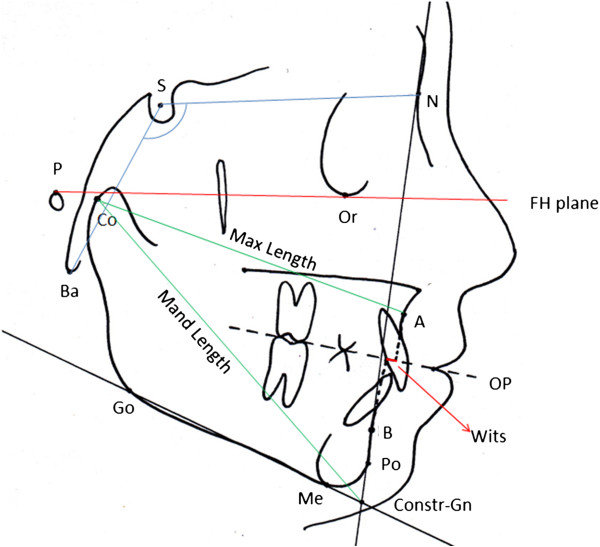
- Nasion (N): The most anterior point on the frontonasal suture. It is a key midline landmark used in numerous angular and linear measurements.
- Sella (S): The midpoint of the pituitary fossa (sella turcica). It is a crucial point for constructing the SN plane and is the apex for many important angles (e.g., SNA, SNB).
- Porion (Po): The uppermost, outermost point on the external auditory meatus. Used to construct the Frankfort Horizontal plane (FH) along with Orbitale.
- Orbitale (Or): The lowest point on the inferior margin of the orbit. Together with Porion, it defines the Frankfort Horizontal plane.
2. Maxillary Landmarks: Defining the Upper Jaw
These points help us assess the position, size, and inclination of the maxilla.
- Point A (Subspinale): The deepest point on the concave curvature between the anterior nasal spine (ANS) and the alveolar crest of the maxillary central incisors. It indicates the anteroposterior position of the maxillary base.
- Anterior Nasal Spine (ANS): The tip of the sharp, bony process of the maxilla at the lower margin of the anterior nasal opening.
- Posterior Nasal Spine (PNS): The tip of the posterior sharp, bony spine of the palatine bone, forming the end of the hard palate. ANS and PNS together define the palatal plane.
- Point A¹: A specific point on the maxillary alveolar process, useful in certain analyses for assessing alveolar prognathism.
3. Mandibular Landmarks: Defining the Lower Jaw
These points are critical for evaluating the position, size, and form of the mandible.
- Point B (Supramentale): The deepest point on the anterior concavity of the mandibular symphysis, between the alveolar crest and the bony chin (Pogonion). It indicates the anteroposterior position of the mandibular alveolar base.
- Pogonion (Pg): The most anterior point on the contour of the chin.
- Menton (Me): The lowest point on the symphyseal shadow of the mandible.
- Gnathion (Gn): A constructed point midway between Pogonion and Menton, representing the midpoint of the chin.
- Gonion (Go): The most posterior and inferior point on the angle of the mandible. It is located by bisecting the angle formed by the ramus and the body of the mandible.
- Articulare (Ar): The point of intersection of the dorsal contours of the posterior border of the mandibular ramus and the temporal bone.
- Condylion (Cd): The most superior point on the head of the mandibular condyle.
4. Dental Landmarks: Assessing Tooth Position
These points relate to the teeth and their position within the jaws.
- Incisor Edge: The tip of the crown of the most anterior maxillary (U1) and mandibular (L1) central incisors.
- Root Apex: The tip of the root of the maxillary and mandibular central incisors.
- Molar Point (U6/L6): The most prominent point on the mesial contour of the crown of the first permanent molar.
5. Soft Tissue Landmarks: The Aesthetic Profile
Modern orthodontics heavily emphasizes the final aesthetic result. These points help us analyze the patient’s facial profile.
- Glabella (G): The most prominent point in the midsagittal plane of the forehead.
- Soft Tissue Nasion (N’): The point of greatest concavity in the soft tissue contour between the forehead and the nose.
- Pronasale (Pn): The most prominent point on the tip of the nose.
- Subnasale (Sn): The point where the nasal septum merges with the upper lip in the midsagittal plane.
- Labrale Superius (Ls): The most anterior point on the vermilion border of the upper lip.
- Labrale Inferius (Li): The most anterior point on the vermilion border of the lower lip.
- Soft Tissue Pogonion (Pg’): The most anterior point on the soft tissue contour of the chin.




Why Are These Landmarks So Important?
- Diagnosis: They allow us to classify malocclusions into skeletal and dental components (e.g., Is a Class II due to a deficient mandible or a prognathic maxilla?).
- Treatment Planning: They are essential for planning orthognathic surgery, growth modification, and camouflage treatment.
- Growth Prediction: By tracing serial cephalograms, we can evaluate the direction and amount of jaw growth.
- Treatment Evaluation: Comparing pre-treatment and post-treatment radiographs quantifies the changes achieved, whether from growth or orthodontic mechanics.
- Aesthetic Analysis: Soft tissue landmarks ensure our treatment goals align with creating a balanced and harmonious facial profile.
Mastering these landmarks is the first step toward cephalometric proficiency. They are the alphabet of the orthodontic language, and fluency allows you to tell the complete story of your patient’s dentofacial structure.